GUIDE 02 · FABRICS · 8 MIN READ
Blackout vs light filtering vs sheer: choosing the right fabric
The fabric you choose decides how a room feels at every hour of the day — more than the shade type, more than the color. The choice comes down to three opacity levels: sheer, light filtering and blackout. Here's how to match each one to how you actually use each room.
The three opacity levels
| Fabric | Light | Privacy (day) | Privacy (night) | Best for |
|---|---|---|---|---|
| Sheer | Soft, view preserved | Partial | Poor | Living rooms with pleasant outlooks |
| Light filtering | Diffused, no glare | Good | Moderate | Kitchens, dining, home offices |
| Blackout | Near zero | Complete | Complete | Bedrooms, nurseries, media rooms |
Two practical notes the table can't show: first, privacy flips at dusk. A light-filtering shade that hides you at noon reveals your silhouette once interior lights are on. Facing a street or close neighbor? You want filtering-plus, or a blackout/dual option. Second, opacity ≠ insulation. Only cellular honeycomb fabrics trap air; a blackout roller dims a room but doesn't meaningfully insulate it.
Room-by-room recommendations
Bedroom & nursery → 100% blackout
Sleep quality is the one place fabric opacity pays off daily. Choose a true blackout fabric and, for the darkest possible room, an outside mount with generous overlap — edge light gaps are fabric-side solvable, mount-side permanent. Tokblind's motorized 100% blackout roller shade ($109.99) is the straightforward pick, and scheduling a morning-open scene from bed is the payoff.
Living room → light filtering, or sheer + filtering layers
Living rooms juggle glare (TVs, screens), view and evening privacy. Light-filtering fabric handles all three for most homes. If your room faces a busy street, a dual roller shade gives you a sheer daytime layer and a privacy or blackout layer in one headrail.
Kitchen & dining → light filtering, moisture-aware
Glare control matters more than darkness here. Pick a smooth, wipeable filtering fabric and avoid textured weaves near cooking zones.
Home office → light filtering with low glare
Backlit windows make video calls exhausting. A filtering shade behind you diffuses daylight without the cave-darkness of blackout — or use a zebra shade and tune the bands during the day.
Media room → blackout, motorized scene
Movie nights want darkness on command. This is the classic use case for a scheduled or voice-triggered motorized blackout shade.
Patio & pergola → outdoor-rated filtering fabric
Outdoor shades use weather-resistant fabric to cut sun and breeze. Indoor fabrics fade and mildew outside — don't cross over. See Tokblind outdoor shades.
Can't decide? Dual roller shades
Dual (double) roller shades mount a filtering roller and a blackout roller on a shared bracket. Daytime runs on the filtering layer; nights and naps drop the blackout layer. It costs more than a single roller but far less than buying two treatments, and it solves the dusk-privacy problem cleanly. We compare it with zebra shades — a related but distinct design — in the shade type guide.
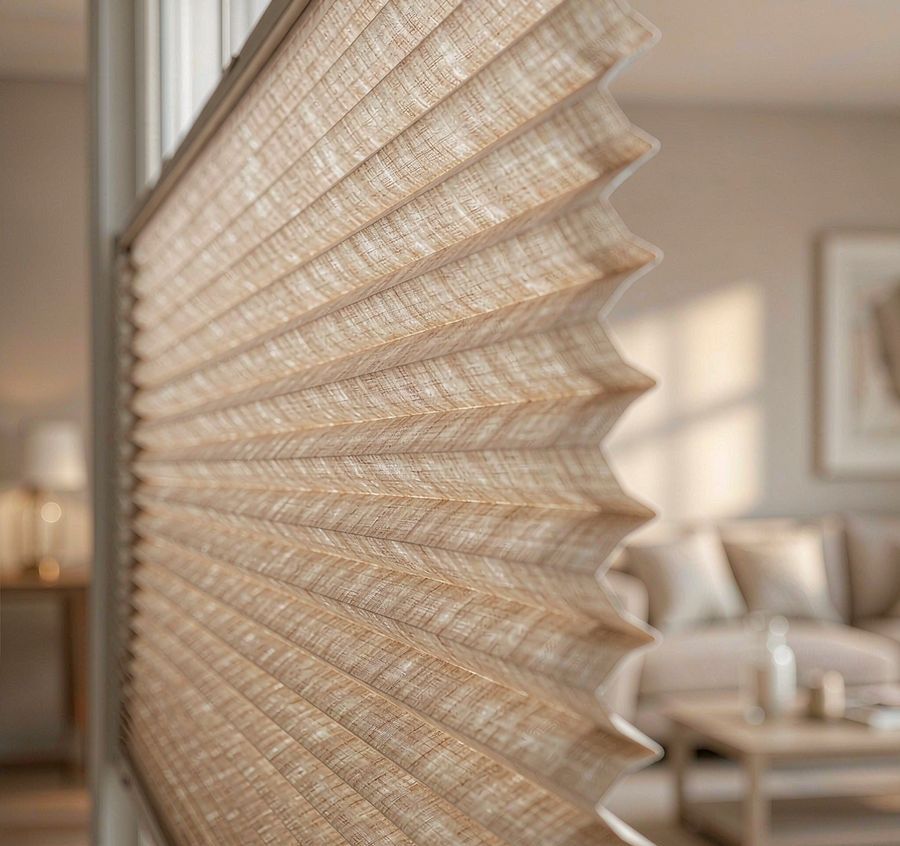
EDITOR'S PICK · COMFORT ROOMS
Motorized Cellular Shades — from $159.99
If energy comfort matters as much as light, cellular honeycomb shades are the fabric architecture to choose: air-trapping cells buffer summer heat and winter drafts, available in light-filtering and blackout versions.
View cellular collection ↗ Affiliate link — we may earn a commission at no extra cost to you.Order fabric samples first — they cost less than a mistake
Colors read differently on screen, under daylight, and at dusk. Tokblind sells swatch kits — blackout fabric samples ($5.99) and light-filtering samples ($5.99) — that let you hold the actual weave against your wall in morning and evening light. Hold the sample flat against the window, not under a lamp: what matters is how it reads backlit.
Fabric FAQ
Are blackout shades really 100% blackout?
The fabric blocks essentially all light, but thin gaps can remain at the edges on an inside mount. An outside mount with 2–3 inches of overlap per side is the most reliable route to a truly dark room.
Can one shade be both blackout and light filtering?
Yes — dual roller shades stack a filtering layer and a blackout layer on one headrail so you can switch between soft daylight and full darkness.
Should I order fabric samples before buying?
Yes, especially if you're between two colors. Swatch kits cost a few dollars and let you judge the fabric backlit in your own room before committing to a custom order.